

Every tree has a story. Some stories deserve revisiting. This is one of them.
Nearly seven years ago, Friends Board member and arborist Claire Corcoran invited readers to discover the remarkable beech trees of the Boston Common and Public Garden, sharing observations and stories of these magnificent trees. Today, we add the next chapter to that story.
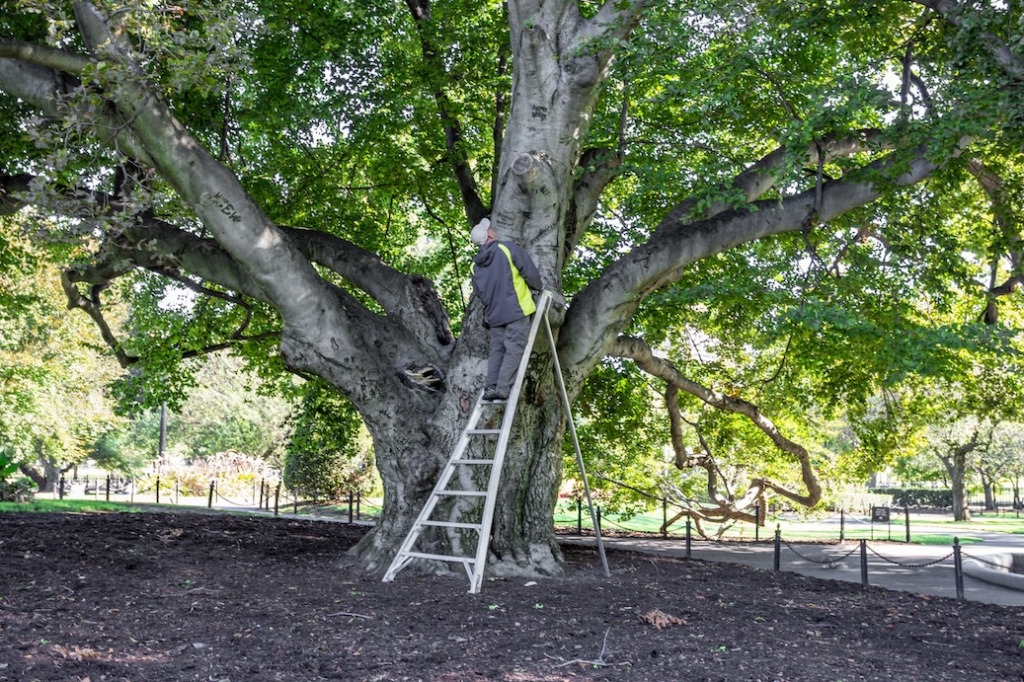
One of the venerable beeches Claire wrote about— a specimen European beech, Fagus sylvatica ‘Pendula’ estimated to be nearly 125 years old— just north of the Bagheera Fountain—has reached the end of its remarkable life.
For decades, this unique tree, with its arching branches reaching out over the surrounding garden, welcomed visitors beneath its intricate canopy which frames one of the Public Garden’s most recognizable pathways. It has shaded conversations, graced countless photographs, and stood as a living reminder that some of Boston’s greatest treasures are also its oldest.
Like all living things, even the most remarkable trees have a natural lifespan. Eventually, time becomes part of every tree’s story.
For years, the Friends of the Public Garden and the Boston Parks and Recreation Department worked together to extend the life of this remarkable specimen through thoughtful, science-based care. Retrenchment pruning in 2020, 2022, and again in 2025 reduced weight on aging limbs while maintaining the tree’s natural form. Specialized nutrition treatments helped strengthen the tree despite increasing internal decay, allowing it to remain a cherished part of the Garden long after many trees in similar condition would have required removal.
After years of careful monitoring and the recent failure of a major limb, the difficult decision was made by the City’s Tree Warden, in collaboration with the Friends and expert consulting arborists, to remove the tree. While this moment is bittersweet, it also reminds us that stewardship is measured not only by the trees we plant but also by the care we provide at every stage of a tree’s life. The parks tell that story every day. Alongside century-old trees are mature specimens in their prime, younger trees growing into tomorrow’s canopy, and new plantings that future generations will one day admire. Together, they remind us that caring for a historic landscape means honoring the past while preparing for the future.
Stewardship Never Stops
While one chapter closes for this remarkable beech, the work of caring for Boston’s historic tree collection continues daily.
The Friends care for nearly 1,700 trees across Boston Common, the Public Garden, and Commonwealth Avenue Mall. Each tree receives regular assessment, and many receive specialized tree care designed to extend their lives and improve their resilience against disease, pests, and the challenges of growing an urban environment.
The beech collection continues to receive that same attention. As Beech Leaf Disease spreads throughout the Northeast, the Friends have begun proactively treating the parks’ beeches with fungicide infusions to help protect these remarkable trees. Eight beeches have already received treatment, with additional trees scheduled in the years ahead. Thanks to the generosity of our supporters, we are able to invest in this kind of long-term, preventative care before problems become irreversible.
Protecting and Maintaining Boston’s Iconic Elms
The Friends work extends well beyond the beeches.
The Friends currently care for nearly 400 elms throughout Boston Common, the Public Garden, and Commonwealth Avenue Mall. It is one of the city’s most iconic tree collections.
Dutch Elm Disease remains the greatest threat to these historic trees. Throughout the year, our tree care specialists closely assess every elm, monitor the elm bark beetle population, provide targeted tree health and nutrition treatments, and administer preventative fungicide infusions on a three-year cycle to strengthen the collection against disease. Despite these efforts, Dutch Elm Disease can still occur.
This summer, two elms, one in Boston Common and one in the Public Garden, were diagnosed with Dutch Elm Disease and must be removed to help protect the surrounding trees. While removing a mature tree is always difficult, prompt action is one of the most effective ways to slow the spread of the disease and preserve the larger collection.
While some elm trees succumb to Dutch Elm Disease, our tree care program has many more stories of tree protection and preservation than loss. Earlier this season, arborists were able to prune out an infected section of wood from a different Public Garden elm before it spread through the tree. Thanks to that intervention, the elm is expected to remain a healthy part of the landscape for years to come.
Stewardship is seldom defined by a single outcome. Sometimes it means extending the life of a beloved tree for decades. Sometimes it means catching disease early enough to save it. And sometimes, despite best efforts, it means making the difficult decision to protect the “forest” rather than an individual tree.
Even a Stump Has a Purpose
A tree’s story doesn’t end when it comes down.
After a diseased elm is removed, it may look like the work is over. In reality, some of the most important work has just begun.
Rather than immediately grinding out the stump, it is left in place and treated to help reduce the risk of Dutch Elm Disease spreading through underground root grafts to neighboring trees. Fungicides are administered to the roots of the tree through the “living stump”.
This quiet but highly effective practice is another example of the long-term thinking that guides every aspect of our stewardship. Each decision is made not only for today’s landscape but for the generations of trees that will define these parks long into the future.
A Living Legacy
The landscapes of Boston Common, the Public Garden, and Commonwealth Avenue Mall are living collections that are continually evolving. Trees planted by previous generations make way for those that will shelter future generations. What we care for today becomes part of the park experience tomorrow. Each mature tree bares the fingerprints of numerous park staff, arborists, volunteers, donors, and park visitors who helped ensure it could thrive for as long as possible.
As you revisit Claire Corcoran’s reflections below, you’ll meet the beeches as she introduced them nearly seven years ago—not simply as magnificent trees, but as living landmarks whose stories continue to unfold.