

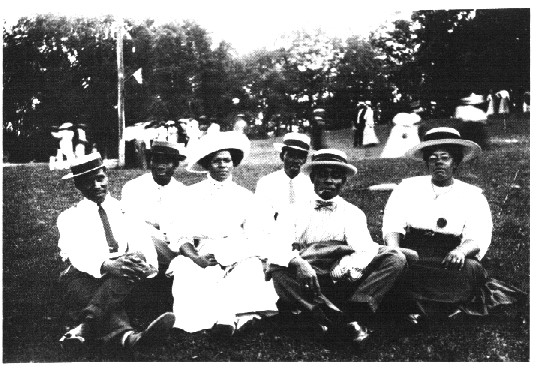
(Image credit: “African-Americans in Boston,” Richard C. Hayden, 1991)
Boston Common occupies land historically populated by Indigenous peoples. For nearly four centuries, the Common has served as a site for public use and gatherings, civic actions, and events. The following timeline traces African American presence on the Common from the 1600s to the present day.
The 1600s–1700s: Enslavement, Early Symbolic Leadership, and Black Community Life
African American history in Boston dates to the city’s founding. Slavery was embedded in Boston’s economic and social structure. (Disappearing from Abolitionism’s Heartland: The Legacy of Slavery and Emancipation in Boston, 2025)
Enslaved and free Black Bostonians lived, worked, and moved through the Common and its borders. Colonial authorities sometimes used the Common for punishment and public discipline. (Boston Common, 2024) It was also a site for daily activities, news, and the exchange of ideas.
Black Bostonians were denied citizenship rights, voting, jury service, and political power. They endured the threat of abduction and being sold into slavery elsewhere, even as Massachusetts moved toward abolition. (Boston Vigilance Committee, n.d.)
In 18th- and early 19th-century Boston, African American community life developed in close relationship to the city’s public spaces-including Boston Common, Beacon Hill, and the streets and neighborhoods surrounding them. During this period, Black Bostonians-many of whom were enslaved or otherwise excluded from formal civic participation-created their own traditions of ritualized and symbolic leadership.
Across New England, and including Boston, African American communities periodically selected respected individuals who were sometimes referred to as “governors” or “kings.” (Connecticut’s Black Governors, 2024) In Boston, these roles were most visible during public gatherings and seasonal celebrations, when Black residents came together in common areas to socialize, mark holidays, and maintain social ties.
These titles did not represent elected office or legal authority within colonial or sState government. They recognized individuals who served as organizers, mediators, spokespeople, and caretakers within Black Boston. Early community leaders helped resolve disputes, sustain social networks, and provide aid in the absence of political power. (Prince Hall, 2024)
Boston Common and the north slope of Beacon Hill were among the few places where large gatherings could occur, offering African Americans opportunities for visibility, assembly, and cultural expression before their full citizenship was granted. (Boston African American National Historic Site, 2024)
Early traditions of gathering, leadership, and collective visibility in and around Boston Common set the stage for 19th-century abolitionist rallies and later Civil Rights marches and protests.
Abolitionists
By the 19th century, Boston Common was used as a platform for the abolitionist movement. Public meetings and rallies opposing slavery drew interracial crowds and opposition.
African American leaders and community members used the Common to protest slavery and claim civic presence in a city that often denied them access to private or institutional power. These occasions often connected Boston’s Black community to national abolition movements. (GBH News, 2023)
The Civil War
The Civil War transformed the Common once again. Troops assembled and trained on the grounds, and sacrifice and service became part of the park’s story. (Boston Common (U.S. National Park Service), 2025)
The Robert Gould Shaw and the 54th Regiment Memorial honors the 54th Massachusetts Volunteer Infantry, one of the first officially sanctioned African American regiments in the Union Army. The memorial acknowledges Black citizenship and service in Boston’s history. (Robert Gould Shaw and Massachusetts 54th Regiment Memorial, 2025)
Collective Voices for Civil Rights
During the Civil Rights Movement, Boston Common was a site of marches, rallies, and demonstrations addressing segregation in schools and housing, economic inequality, and institutional racism. National figures and local organizers used the Common to make demands for justice and equity. (Press, 2025)
The Common persisted as a place for public confrontation of inequities.
Remembrance, Protest, and Celebration
In recent years, Boston Common has remained a gathering place for protests against racial injustice, commemorations, and cultural events, and other historic celebrations.
Civic and community leaders have expanded how this history is interpreted and shared through new monuments, notably The Embrace, which was installed on the Common in 2022. These efforts have influenced the Common’s use as a site for public assembly and reflection. (The Embrace and the 1965 Freedom Plaza by Hank Willis Thomas and MASS Design Group, 2025)
Stewardship of a Living History
Boston Common is intended as a public park for everyone.
Recognizing the African American history of Boston Common helps ensure this public greenspace lifts the people and stories that have influenced it throughout its 400-year history.
References
(2025). Disappearing from Abolitionism’s Heartland: The Legacy of Slavery and Emancipation in Boston. International Review of Social History 65(1). https://doi.org/10.1017/S0020859020000176
(2024). Boston Common. Wikipedia. https://en.wikipedia.org/wiki/Boston_Common
(n.d.). Boston Vigilance Committee. Wikipedia. https://en.wikipedia.org/wiki/Boston_Vigilance_Committee
(June 9, 2024). Connecticut’s Black Governors. Northeastern Global News. https://news.northeastern.edu/2024/06/10/magazine/black-election-day-history/
(2024). Prince Hall. Wikipedia. https://en.wikipedia.org/wiki/Prince_Hall
(2024). Boston African American National Historic Site. National Park Service. https://www.nps.gov/boaf/index.htm
(July 18, 2023). Black people were once banned from the Boston Common. GBH News. https://www.wgbh.org/news/local/2023-07-19/black-people-were-once-banned-from-the-boston-common
(2025). Boston Common (U.S. National Park Service). National Park Service. https://www.nps.gov/places/boston-common-ma.htm
(2025). Robert Gould Shaw and Massachusetts 54th Regiment Memorial. National Park Service. https://www.nps.gov/places/robert-gould-shaw-and-massachusetts-54th-regiment-memorial.htm
Press, A. (April 25, 2025). Boston celebrates 1965 Freedom Rally led by MLK as advocates urge continued fight against injustice. AP News. https://apnews.com/article/8256f61320a2466ecd8d20417405c500
(2025). The Embrace and the 1965 Freedom Plaza by Hank Willis Thomas and MASS Design Group. Boston.gov. https://www.boston.gov/embrace-and-1965-freedom-plaza-hank-willis-thomas-and-mass-design-group